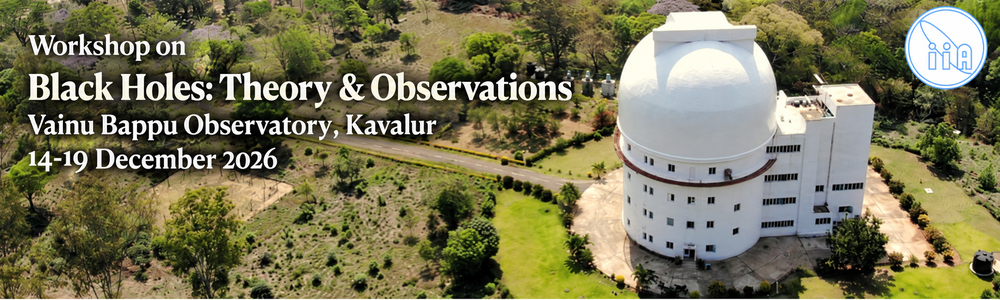
In recent years, black holes have taken an increasingly prominent role across astronomy, astrophysics, and fundamental physics. Following the first gravitational-wave detections, the Event Horizon Telescope images of M87* and Sagittarius A*, and rapid progress in time-domain and multi-messenger astronomy, black-hole research has entered an exciting new phase. The growing population of compact-object mergers detected by LIGO–Virgo–KAGRA, advances in horizon-scale imaging and polarization studies, and increasingly sophisticated numerical simulations are providing new insights into black-hole formation, accretion, jets, and strong gravity. Looking ahead, next-generation electromagnetic facilities and the future space-based gravitational-wave observatory LISA will further expand this frontier. Their combined capabilities promise a deeper understanding of black holes across the mass scale and their role in cosmic evolution.
Who can apply ?
The students who:
- are currently pursuing their M.Sc. degree or Int. Masters degree and will be completing by June 2027 or by June 2028 in the disciplines of Astronomy/Physics/Mathematics.
- have successfully completed their M.Sc. degree or Int. Masters degree during the year 2025 in the disciplines of Astronomy/Physics/Mathematics.
- Early year Ph.D. students, 1st or 2nd year.
Only limited applicants will be selected for participation based on their academic records and motivation to attend the school.
