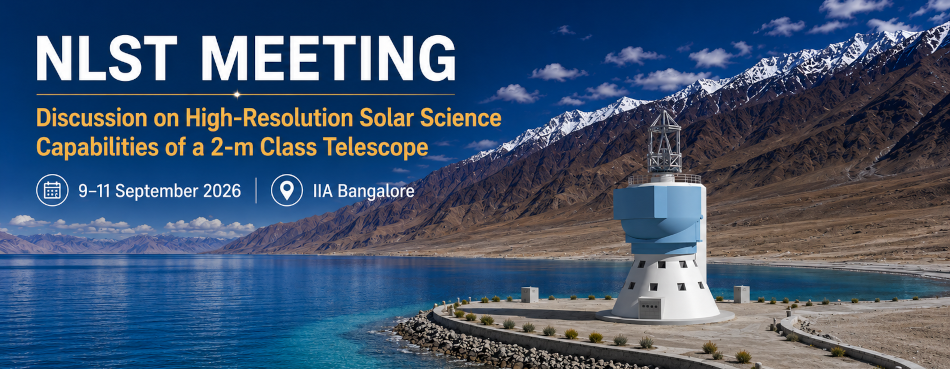
The National Large Solar Telescope (NLST) will be India's flagship 2-m class ground-based solar telescope, designed to provide unprecedented high-resolution observations of the solar atmosphere. With its exceptional spatial, spectral, and temporal resolution, NLST will enable transformative studies of fundamental solar processes, including magnetic field structuring, energy transport, wave dynamics, small-scale transients, coronal heating, and solar eruptive phenomena.
This meeting aims to bring together the Indian solar physics community to define and consolidate the key science opportunities enabled by NLST. The discussions will focus on identifying the highest-priority science drivers, translating them into quantitative observational requirements, and aligning them with the capabilities of the first-generation backend instruments. The meeting will also review the current status of the NLST project and discuss instrument development, observing strategies, and future scientific priorities.
A major objective of the meeting is to establish coordinated national science working groups that will help guide instrument development, optimize scientific operations, and maximize the scientific return of NLST in synergy with existing and upcoming ground- and space-based solar observatories.
The meeting will provide a unique forum for scientists, astronomy instrument developers, and students working in solar and heliospheric physics to contribute to shaping the scientific vision of India's next-generation solar telescope.
Key Objectives
- Review the current status and future plans of the NLST project.
- Discuss the development and capabilities of the first-light backend instruments.
- Define high-impact science cases enabled by high-resolution solar observations, and gather community input on the corresponding instrument specifications and observational requirements.
Important Information
- Online participation is open to all members of the Indian solar physics community.
- In-person participation and oral presentations are by invitation only.
- Registration closes on 15 August 2026
30 July 2026. - No travel support is available for in-person participants.