
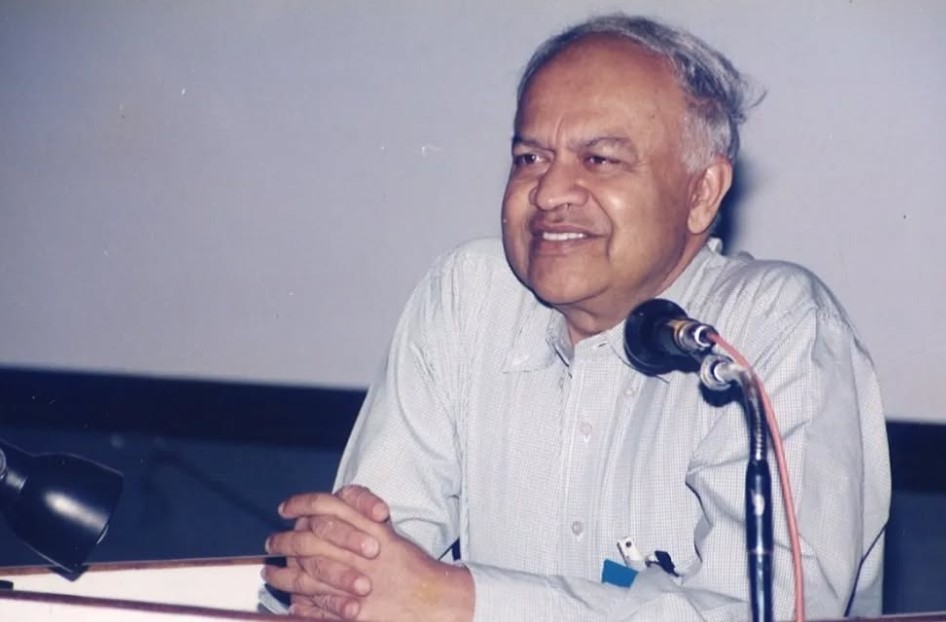
Prof. Jayant Vishnu Narlikar
(19 July 1938 – 20 May 2025)
We are honoured to dedicate the ASI Symposium for Communicating Astronomy in India 2026 (ASI SCAI-26), to the memory of Prof. Jayant Vishnu Narlikar.
Prof. Jayant Vishnu Narlikar was not only one of India’s foremost cosmologists but also one of its most influential science communicators. Recognizing that science must reach beyond laboratories and journals, he devoted immense efforts to public outreach throughout his life. As the founding director of the Inter-University Centre for Astronomy and Astrophysics (IUCAA) in Pune, he shaped it not only as a world-class research institute but also as a public-facing centre for astronomy outreach and science education.
Narlikar’s deep commitment to science communication began remarkably early in his career. While still a young researcher in Cambridge in the early 1960s, influenced greatly by his mentor Prof. Fred Hoyle, he wrote his first popular-science article for the magazine "Discovery", explaining the physics of gravitational collapse and the newly discovered quasars for a general audience. During this period he also delivered many popular lectures to undergraduate societies in the U.K., experiences that shaped his lifelong belief that scientific concepts, no matter how complex, should be accessible to everyone. These early efforts laid the foundation for the distinctive clarity and warmth that would later define his communication style in India.
After returning to India in 1972 to take up a position in the Tata Institute of Fundamental Research (TIFR), Narlikar continued to write extensively for newspapers and science magazines, bringing frontier research in cosmology to Indian readers. His writings—eventually numbering more than 400 popular articles—appeared in English, Hindi, and Marathi, reflecting his insistence that science must speak in the languages of the people. He also began contributing regularly to radio and television programmes, using these platforms to counter superstition, convey scientific reasoning, and nurture a rational outlook in society. Even as he produced world-class research, he remained committed to explaining the wonders of the cosmos to curious readers and listeners across India.
His outreach vision took a major institutional leap with the founding of the Inter-University Centre for Astronomy and Astrophysics (IUCAA) in Pune in 1988. From the beginning, Narlikar and his colleagues established a structured and ongoing programme of popular lectures, teacher-training sessions, sky-watching events, and open houses. One of the hallmark initiatives was the monthly “Second Saturday” programme, which brought students and teachers from dozens of schools into direct contact with astronomers, experimenters, and IUCAA educators. His belief was simple yet profound: if children experience science first-hand, they will never again see it as intimidating.
Prof. Narlikar also championed school-level research exposure, initiating summer programmes where selected school students could spend several weeks at IUCAA interacting with scientists and carrying out small projects. At a time when hands-on scientific training for school children was rare, this programme opened doors for young minds to observe active research environments and explore astronomy through experiments, models, and discussions. Many participants went on to pursue careers in science, often citing these interactions with Narlikar and IUCAA faculty as a formative influence.
His influence extended strongly into television and film media, where he helped create some of India’s earliest and most impactful astronomy programmes. In the early 1980s he appeared in a Marathi-language educational series, Akashashi Jadale Nate (“Our Bond with the Sky”), which introduced the fundamentals of astronomy through conversations, visual demonstrations, and slides. Later, inspired in part by the storytelling approach of Carl Sagan’s Cosmos, he conceived the Hindi television series Brahmand (“The Universe”), a 17-episode production of the Films Division of India. This series reached millions of viewers nationwide and remains one of the most ambitious Indian science-communication projects of its time. His science fiction story Dhoomaketu ("the Comet") has been made into a 2-hour film by the Children's Film Society of India. In the 1990s Narlikar also appeared in the very popular TV cultural magazine programme Surabhi answering viewers' questions on science.
Complementing all of this was his rich literary output—popular-science books, children’s stories, science fiction, and essays that blended scientific ideas with imaginative narratives. Works such as "The Seven Wonders of the Cosmos", "The Lighter Side of Gravity", and his many Marathi books helped generations of young Indians encounter science not as a dry academic subject but as a source of joy, curiosity, and wonder. As a novel experiment towards science dissemination, Narlikar asked autograph-hunting schoolchildren to send him postcards with some scientific questions to which he would reply with his signature. A subset of this was published, as a booklet called Postcardatun vidnyan ("Science through postcards").
Across print, broadcast media, institutional outreach, and personal interactions, Prof. Jayant Narlikar transformed astronomy from a specialist discipline into a vibrant part of India’s public culture. For his contributions for science popularization, Professor Narlikar was awarded the Indira Gandhi Prize by the Indian National Science Academy in 1990, and the Kalinga Prize by UNESCO in 1996. His legacy endures not only in the scientific and outreach community but across generations in the countless students, teachers, and enthusiasts whose love for the night sky he awakened.
